
World
Ebola needs swift response to prevent catastrophe, says DR Congo governor
May 26, 2026 International Source: BBC World


The governor of Ituri said the more time they lose, the closer the province is to disaster.
Ebola in DR Congo: Fast response needed to stop 'catastrophe', DR Congo governor sayss
Copyright current_year BBC. All rights reserved. The BBC is not responsible for the content of external sites. Read about our approach to external linking.
Copyright current_year BBC. All rights reserved. The BBC is not responsible for the content of external sites.
Read about our approach to external linking.
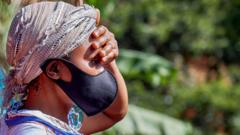
People in the affected areas are wearing face masks and avoiding contact with others to prevent the spread of Ebola
A head-only side profile of a woman facing right. she has a scarf wrapped around her head and is wearing a black protective face mask. She has her left hand over her eyes to shield from the sun.
Ebola needs swift response to prevent catastrophe - DR Congo governor
The military governor of the Democratic Republic of Congo's Ituri province, the epicentre of the current Ebola outbreak, has likened the struggle to contain the spread of the virus to a "war" for which they are lacking resources to fight.
"People in affected areas are not receiving enough food," Johnny Luboya Nkashama told French broadcaster RFI, adding that "other diseases" and "overcrowding" are also issues.
He called for a "swift response", including strengthening the capacity of staff to prevent Ituri "from descending into catastrophe".
Officials say there are more than 900 suspected cases of Ebola, and 223 suspected deaths, since the outbreak was declared on 15 May.
The World Health Organization (WHO) said the disease may be spreading faster than originally thought and has declared a public health emergency of international concern.
On Monday, WHO director-general Tedros Adhanom Ghebreyesus, who is due to travel to DR Congo, has said the Ebola outbreak is outpacing urgent efforts to scale up a response adding that responders were "playing catch-up".
Ebola has also been reported in DR Congo's North and South Kivu provinces, as well as in neighbouring Uganda, where there have been seven confirmed cases.
Elaborating on what his province needs, Kashama explained "qualified personnel" should be deployed as soon as possible and "secure treatment centres" established.
Angry relatives trying to claim the bodies of loved ones who had reportedly died of Ebola have targeted two treatment centres.
"Our existing resources were dedicated to the war, and this second war that is now upon us demands even more," he said on RFI.
A medic checks the temperature of a woman, using a contactless infrared thermometer. Only the arm of the medic, who is wearing white, is shown. The woman having her temperature checked has her hair in braids. She is wearing a bright blue top with a pattern and is standing next to a blue wooden door with a white and blue building in the background.
What is Ebola and why is stopping the latest outbreak so difficult?
Ituri has been under military rule since 2021, when the civilian authority was replaced by a military general in an attempt to neutralise dozens of armed groups which have operated in the area for many years. These include the Allied Democratic Forces (ADF), affiliated to the Islamic State group.
"And lastly, we need to mobilise financial resources - they must be made available," the governor said. "The more time we lose, the closer we come to disaster."
On Saturday, the head of Africa Centres for Disease Control and Prevention (Africa CDC), met with health ministers from DR Congo and Uganda and South Sudan to finalise their cross-border co-ordination in response to the outbreak.
Africa CDC director-general Dr Jean Kaseya said they also agreed on a $319m (£236m) budget to stop the outbreak from spreading.
He told BBC World Service's Newsday on Monday, that 10% of the money had been secured from the affected countries.
Map of eastern DR Congo and Uganda showing areas affected by an Ebola outbreak. Shaded red regions mark locations with reported cases, concentrated in Ituri province, including Mongwalu, Rwampara, Nyakunde, and nearby Bunia, identified as the site of the first suspected case. Additional smaller affected areas are shown around Butembo, Goma near the Rwanda border, and a location near Kampala in Uganda, where cases were confirmed in travellers from DR Congo. A locator inset highlights the region within Africa.
On the same day, South African President Cyril Ramaphosa pledged an initial $5m to support the plan.
Kaseya added that African businessmen will be meeting later this week to "raise additional funds", while international partners were also "committing funds".
Africa CDC has warned that other countries on the continent - namely Angola, Burundi, the Central African Republic, Ethiopia, Kenya, Rwanda, South Sudan, Tanzania and Zambia - were at risk from an outbreak.
This outbreak is the 17th to have emerged in DR Congo since Ebola was discovered in 1976.
It is only the third worldwide of the rare Bundibugyo species of Ebola, which has not been seen in over a decade.
There are currently no vaccines or medications that target Bundibugyo, but vaccines are currently in development.
Last week, the WHO said it could take up to nine months for a vaccine to be ready.
A person wearing a mask and peach headwrap is having their temperature checked with a contactless thermometer near their ear. it reads 36.3 degrees.
'Ebola has tortured us': Fear grips eastern DR Congo as deadly virus spreads
The image shows a laboratory setting with bright, clean lighting and smooth surfaces. A person is wearing protective clothing, including a blue gown, gloves, a face mask, and a head covering. The person is using a pipette to transfer liquid into a small tube placed in a rack. A clear protective barrier is positioned in front of the workspace, suggesting a sterile or controlled environment. The background includes lab equipment and reflective surfaces, reinforcing the clinical and scientific atmosphere.
UK scientists developing Ebola vaccine that could be ready for trials in months
The image depicts a group of individuals dressed in full-body protective suits, complete with face masks, goggles, and bright orange gloves. Their attire suggests they are engaged in a high-risk operation, likely involving hazardous materials or infectious disease control. They are working outdoors in what appears to be a forested or rural environment, with greenery and natural terrain surrounding them. The scene conveys a sense of urgency and seriousness, as the protective gear is designed to minimise exposure to dangerous contaminants.
'Speed, money and compassion' - lessons from an Ebola survivor and other experts
A woman looking at her mobile phone and the graphic BBC News Africa
Go to BBCAfrica.com for more news from the African continent.
for more news from the African continent.
Follow us on Twitter @BBCAfrica, on Facebook at BBC Africa or on Instagram at bbcafrica
Unrest between crowds trying to reclaim the bodies of suspected Ebola cases and authorities have continued.
Kate White says she is "extremely concerned about the inability to get resources" to the Democratic Republic of Congo.
They are thought to have caught the virus before the outbreak was identified, the Red Cross says.
Cyril Ramaphosa argues that the authors of the report "misconceived" their mandate.
As speaker, Sonko could use his position to challenge the policies of the president, his one-time ally.
The United Arab Emirates has denied any involvement in the civil war and says it investigates alleged links.
Four people were also injured in the incident inside Murchison Falls National Park, officials say.
Some speculate that El Malick Ndiaye stepped down so that ousted-PM Ousmane Sonko can take his place.