World
Iran war shows norms of international conflicts have been overturned
March 24, 2026 International Source: BBC World


US threats against energy infrastructure, and Iran's retaliation on its Gulf neighbours, signal a clear change.
Iran war shows norms of international conflicts have been upended
Trump: 'We'll just keep bombing our little hearts out' if no deal with Iran
Why is Israel targeting Lebanon's bridges?
Copyright current_year BBC. All rights reserved. The BBC is not responsible for the content of external sites. Read about our approach to external linking.
Copyright current_year BBC. All rights reserved. The BBC is not responsible for the content of external sites.
Read about our approach to external linking.
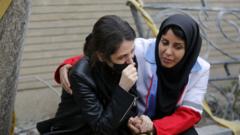
A woman consoles another woman who cries while sitting on the side of the street in Tehran on Monday.
Iran war shows norms of international conflicts have been overturned
US-Israeli attacks on Tehran collapsed an eight-story residential building in the Enderzgu district on Monday
A view of a residential building damaged by a strike, amid the US-Israeli conflict with Iran, in Tehran, Iran, March 23, 2026
The US-Israeli attacks against Iran, and the threats against its energy infrastructure, as well as Tehran's retaliation on its Gulf neighbours underline how the norms of starting and escalating international wars have been upended.
US President Donald Trump has at least twice threatened to use overwhelming force against Iranian energy facilities. Last week, he said he would "massively blow up" Iran's South Pars gas field if Iran further retaliated against Qatari energy sites. And on Saturday, he said the US would "obliterate" Iran's "various power plants, starting with the biggest one first" if its leaders did not reopen the Strait of Hormuz.
It comes amid mounting concern that the nature of this war is putting further, unprecedented strain on the global rules-based order.
Luis Moreno Ocampo, founding chief prosecutor of the International Criminal Court (ICC), said the global rules-based order was designed to protect civilians and prevent nations resorting to war other than in self-defence, or when approved by the UN Security Council.
He told the BBC that the war on Iran amounts to a crime of aggression under international law.
Moreno Ocampo also said Trump's threats to bomb Iranian power plants, as well as attacks by both Iran and Israel on energy infrastructure, do not amount to legitimate targets. He likened such strikes to Russia's attacks on energy sites in Ukraine which led to Russian officials being indicted by the ICC for alleged war crimes.
"The cases of Russia in Ukraine or the US in Iran or in Venezuela is… called a crime of aggression. That means the use of armed forces by a state against the sovereignty, the territorial integrity or the political independence of another state, that's it," said Moreno Ocampo.
"Now we go [from the rules-based system] to the rule of the man, whatever today President Trump decides will be the rule. That's not a viable world," he said.
Trump: "We'll just keep bombing our little hearts out" if no deal with Iran
Trump waves his hands while speaking to reporters outside Air Force One.
In response, the White House called Moreno Ocampo's statement "ridiculous". It said Trump was taking "bold action to eliminate the threat posed by a rogue, terrorist regime".
Iran's killing of civilians in the region underscored "the importance of the president taking this action," a White House official added.
Asked about concerns over US attacks on Iranian power plants amounting to war crimes, US Ambassador to the United Nations Mike Waltz told CBS News on Sunday: "When you have a regime that has its grips in so much critical infrastructure that is using it to further not only the repression of its own people, to attack its neighbours, and in contravention of UN sanctions to march towards a nuclear weapon, then that makes those legitimate targets."
Moreno Ocampo, however, said Iran's attacks on its Gulf neighbours - which had not attacked it - would also be seen as a crime of aggression under international law.
Neither the US, Israel or Iran are members of the International Criminal Court. Still, the Trump administration has sanctioned several of the court's judges in retaliation for its previous investigations into the US and Israel.
Residents react in the wake of the strikes in Tehran on Monday
Under the Rome Statute, which established the court, "intentionally directing attacks at civilian objects... which are not military objectives" is defined as a war crime, he said.
While civilian sites can lose their protection if they are used for military purposes, in such cases attacks must adhere to principles of international humanitarian law including distinguishing between combatants and civilians.
Rights groups say attacking Iranian power plants could have a devastating impact on civilian life, given Iranians are already suffering from power outages with electricity often needed to pump water to homes.
Iran said if the US carried out such a strike it would attack the energy and water systems of its Gulf neighbours in retaliation. On Monday, Trump said he was postponing his threat for five days and said Iran was negotiating, which Iranian officials denied.
During the war missiles have also landed close to nuclear facilities in Iran and Israel. The World Health Organisation said that the conflict was at a "perilous stage" and called for restraint.
Brian Finucane, a former state department lawyer, told the BBC if Trump carried out threats against Iran's energy facilities, "it's hard to see how any such attack would be lawful. He's ready to attack things which are not obviously lawful military objectives."
BBC's Middle East correspondent Hugo Bachega looks into Israel's targeting bridges in Lebanon
Bridge explosion in Lebanon split screen with Hugo Bachega
Israeli airstrikes have targeted multiple fuel depots in and around Tehran, creating immense fireballs and sending thick columns of smoke into the air.
Iran has attacked energy infrastructure in Qatar, the UAE, Saudi Arabia, Bahrain, Kuwait, Oman, Iraq and Israel. The International Energy Agency (IEA) has said since the start of the war at least 40 energy assets across nine countries have been "severely or very severely" damaged.
The UN Security Council has condemned Iran's attacks on its Gulf neighbours. But critics argue the West's condemnation of Iranian violations of international law is undermined by the US openly appearing to abandon such norms.
Brian Katulis, a former national security official under both Democrat and Republican administrations, said Trump's threats came in the context of a "very dicey moment for the international order".
He told the BBC that US threats on energy infrastructure and its actions in Iran and Venezuela sent a signal: "You can do as you please. The jungle has grown back. In some ways it just follows the currents that were already in the international system that were accelerating".
Katulis argued Trump's inability to effectively raise a coalition to secure the Strait of Hormuz was a direct result of allies losing trust in the US.
He also said the Trump administration was creating an era of "thugboat diplomacy".
The White House rejected this. An official said President Trump had restored America's place as the most powerful country in the world, to protect the US and its allies against the threat of a nuclear armed Iran.
"His predecessors talked about curtailing Iran's threat for 47 years, but did nothing about it – instead, they opted to preserve the status quo while allowing the terrorist regime to build up its destructive capabilities".
A shot of Donald Trump from the shoulders up, wearing a navy suit with a light blue tie.
Trump says 'good' talks ongoing with Iran - but offers few details
A man looks at his phone and a woman next to him covers her face with her hands in a bomb shelter in Tel Aviv (18/03/26)
US' and Iran's options for ending war narrow the longer it goes on
An Israeli self-propelled howitzer artillery gun fires rounds, with balls of fiery smoke around the weapon shooting into the air. The machine is surrounded by a dirt trench, with a grassy hill in front of it.
Israel to expand ground and air attacks against Hezbollah in Lebanon
President Trump says the US is already dealing with a "top person" in Iran, but Tehran denies that any talks have begun.
Thousands of displaced Lebanese residents will not be allowed to return home until northern Israel is safe, Israel's defence minister says.
The Iran-born Bishop of Chelmsford expresses her concerns about the war in the Middle East.
Global energy prices had plunged on Monday after Trump said he had postponed strikes on Iranian power plants.
Two pilots died after a passenger plane collided with a fire truck at New York's LaGuardia Airport.
BBC Verify breaks down the moments before the deadly collision with a fire truck at the New York airport.
Investigators released details from the final three minutes of cockpit and tower communications, which showed controllers cleared both the plane and a fire truck to cross the runway.
But I can change it: Some Iranians dismiss the possibility of talks to end the war, others worry a deal may leave the current leaders in place.