
World
Nigeria begins mass trial of 500 terrorism suspects
April 8, 2026 International Source: BBC World


Very few people are ever prosecuted following terror attacks with suspects often held without trial.
Nigeria begins mass trial of 500 terrorism suspects
Copyright current_year BBC. All rights reserved. The BBC is not responsible for the content of external sites. Read about our approach to external linking.
Copyright current_year BBC. All rights reserved. The BBC is not responsible for the content of external sites.
Read about our approach to external linking.
Very few people have ever been prosecuted over attacks that have mainly taken place in northern Nigeria
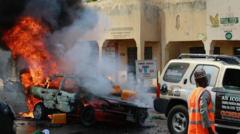
A car on fire after bombing in Nigeria's north eastern Gombe state in 2015
Nigeria has begun the prosecution of more than 500 people accused of involvement in militant attacks in one of the country's largest ever terrorism trials.
The suspects face charges linked to aiding and abetting terrorism, particularly in the north-east where an insurgency by the Boko Haram Islamist group began 17 years ago.
Since then insecurity has spread to many other areas of the West African nation, leaving communities, often those in rural areas, at the mercy of mushrooming militant groups and gangs that kidnap for ransom.
The mass trial opened on Tuesday at a high court in the capital, Abuja, where 227 suspects were arraigned before 10 judges, according to the attorney general.
Hundreds of people have lost their lives in bombings and various attacks across Nigeria this year alone.
Very few people are ever prosecuted over terror attacks - and suspects are often detained and spend years in custody without facing trial.
According to the AFP news agency, gunmen killed at least 20 people on Wednesday in the western state of Niger. Residents say the attackers raided villages in Shiroro district, an area where kidnapping gangs and Islamist militants are known to operate.
A bandit in Zamfara state dressed in dark blue and holding a gun over his shoulder walks away from the camera in a forested area.
The kidnap gangs, jihadists and separatists wreaking havoc in Nigeria
Security was tight during the court session on Tuesday, with suspects transported in heavily guarded convoys under military, police and intelligence supervision.
International observers, including human rights groups and the Nigerian Bar Association, were also present in court.
The defendants are alleged to have taken part in attacks mainly in northern Nigeria, while others face charges of supporting militants through funding, supplying arms and logistics.
Five of the accused have already been given varying jail terms - from seven to 20 years - after pleading guilty to charges that included selling livestock, supplying food and information to militant groups.
Attorney General Lateef Fagbemi said the scale of the operation showed the government's resolve to deal with the matter.
"The federal government is committed to ensuring that due process is followed while bringing those involved in terrorism to justice," he said.
Security expert Bashir Galma, a retired army major, told the BBC that the trial, which is expected to continue in phases, was a "positive development" and a "significant milestone" in Nigeria's fight against terrorism.
"For years Nigerians have been complaining about why they keep these suspects [in custody] instead of making them face the law for what they are suspected of doing," he said.
"This will bring some level of peace for people whose loved ones were killed or injured."
The trial would also dispelled rumours that suspects were routinely released after arrest "so that they can go back to their terrorism business", the analyst added.
However, he predicted that some of the accused could be released soon, given that they were arrested many years ago - a factor he said the judges would likely take into consideration.
Aliyu Abdullahi Isa, a Fulani herder wearing a white knitted hat. Behind him are white cattle grazing
'Peace is a gradual thing': How land, cattle and identity fuel a deadly Nigerian conflict
Two women, dressed as yellow flowers, smile at the camera, wearing sunglasses and petals
Carnival fever hits Lagos as locals celebrate Afro-Brazilian heritage
Lami Ezekiel in front of the home built for her by the government in the late 80s. She appears to be blind in one eye and is wearing a black and red floral dress, She is sitting on the ground next to a saucepan on a wood fire.
'We want a voice in our land' - the people evicted to build Nigeria's capital
A woman looking at her mobile phone and the graphic BBC News Africa
Go to BBCAfrica.com for more news from the African continent.
for more news from the African continent.
Follow us on Twitter @BBCAfrica, on Facebook at BBC Africa or on Instagram at bbcafrica
The state department has also authorised non-emergency embassy staff to leave on security grounds.
The centuries-old Fanti Carnival returned to Nigeria on Monday with a burst of colour and spectacle.
Five civilians were killed by the gunmen and their bodies were recovered at the scene, the army said.
The foreign minister says the accusations, involving children, were investigated and found to be unsubstantiated.
Ex-President Yahya Jammeh's 22-year rule was known for enforced disappearances and extrajudicial killings.
The government usually refrains from commenting on the participation of its citizens in the conflict.
Mourning the deaths, the president says it was a "race against the clock" to find others affected.
The presidency says it is taking action as it fears fuel shortages could lead to public disorder.